5 Patented Escapement Innovations Challenging the 250-Year-Old Lever Escapement
Beyond the Lever Escapement: Patented Innovations Reshaping Timekeeping
For over 250 years, the lever escapement has reigned supreme as the dominant regulating mechanism in mechanical watches. Invented by Thomas Mudge in 1754, this British design became the gold standard after Swiss watchmakers refined it and Georges-Auguste Leschot developed machinery for mass production. Today, approximately 99% of all mechanical watches still rely on the lever escapement. But a wave of patented innovations is challenging this centuries-old monopoly, driven by silicon technology and creative engineering.

The Efficiency Problem
Despite its proven reliability, the lever escapement has a fundamental limitation: up to 30% of the mainspring's energy is lost to friction between the lever and escape wheel, and during impulses to the balance wheel. This energy waste limits power reserve and accuracy potential. Modern alternatives aim to reduce or eliminate this friction while maintaining or improving chronometric performance.
Five Patented Escapement Innovations
1. Omega Co-Axial Escapement (Patented 1974)
British master watchmaker George Daniels invented the co-axial escapement in 1974, and it remains one of the most significant horological developments of the last century. The key innovation: a three-pallet lever design that virtually eliminates sliding friction through pushing actions instead. The escape wheel comprises two stacked gears — one for locking, one for impulses — creating a fundamentally different energy transfer mechanism.
Omega adopted the technology in the 1990s and today uses it in all mechanical watches. The co-axial's reduced friction theoretically enables longer service intervals and improved accuracy, though the widespread adoption of silicon components has somewhat narrowed this advantage.
2. Rolex Dynapulse Escapement (Debuted 2024)
The most recent major entrant, Rolex's Dynapulse escapement debuted with the Land-Dweller in calibre 7135. Unlike the brand's Chronergy escapement (an optimized lever design), Dynapulse uses two escape wheels with a silicon rocker intermediary. The wheels feature just six teeth each — compared to 15-20 in conventional designs — allowing a compact footprint.
The revolutionary aspect: instead of flat impulse surfaces creating sliding friction, Dynapulse uses convex surfaces that create rolling motion, virtually eliminating friction. The result is approximately 30% greater efficiency than a lever escapement, operating at 5Hz (36,000vph) while maintaining the same power reserve as 4Hz movements. Almost the entire assembly is silicon, making this design feasible only with modern materials.
3. Grand Seiko Dual Impulse Escapement (2020)
Introduced in calibre 9SA5, Grand Seiko's Dual Impulse Escapement dissociates locking and impulse functions — similar in concept to the co-axial but executed differently. The star-shaped escape wheel with eight openworked arms (crafted via MEMS technology) is 5% lighter than conventional components, reducing power requirements.
In one direction, power transmits directly to the balance roller. In the other, it receives indirect impulse via the pallet fork. This hybrid approach — direct impulse in one direction, indirect in the other — creates an escapement that's both more efficient and more wear-resistant than the traditional lever.
4. Ulysse Nardin Anchor Escapement (2014)
Eight years in development, the Anchor Escapement exploits silicon's flexibility to create a constant-force mechanism. A silicon pallet fork is freely suspended by two buckled blades (just 15 microns thick — a fraction of a human hair) within a circular frame. These tensioned blades snap back during impulses with consistent force regardless of mainspring state, functioning as a molecular-level spring mechanism.
The result: constant energy delivery to the balance wheel without a traditional remontoire d'égalité. Friction is minimized to the point where no lubricating oil is required. This technology appeared in the Freak Vision and represents a fundamentally different approach to power regulation.
5. Frederique Constant Monolithic Oscillator (2021)
Perhaps the most radical innovation, the Monolithic Oscillator replaces 26 components — balance wheel, hairspring, and parts of the escapement — with a single silicon structure. Created in collaboration with Dutch company Flexous, this 0.3mm-thick oscillator vibrates at 40Hz (288,000vph), ten times faster than standard 4Hz movements.
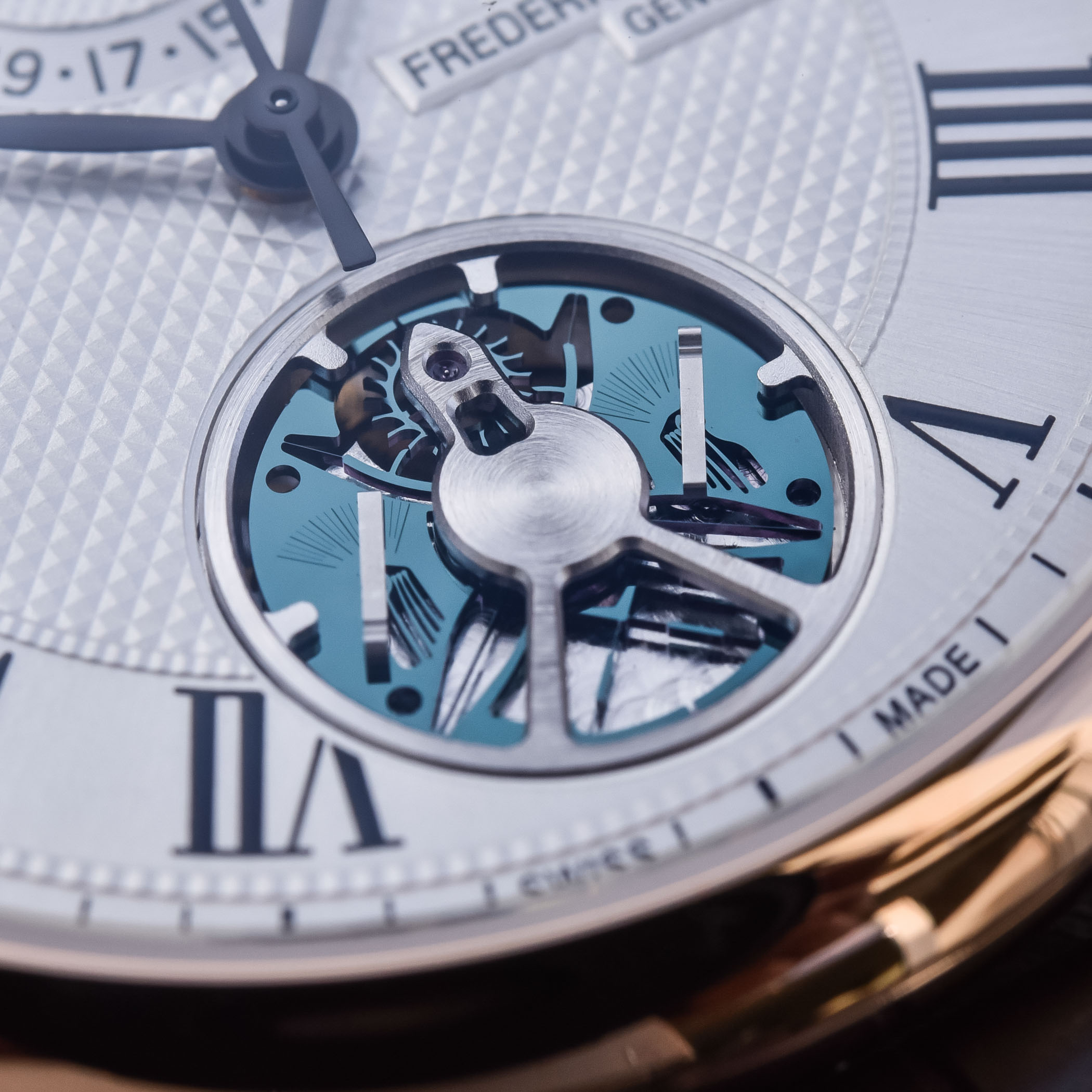
Instead of rotation, the oscillator pivots at just six degrees amplitude. The integrated pallet fork, four flexible blades, and two regulation weights are all etched from a single silicon wafer. While production challenges initially limited the concept, Frederique Constant demonstrated that a sub-EUR 5,000 mechanical watch could achieve chronometric performance approaching quartz territory.
Comparison Table
| Escapement | Brand | Frequency | Key Innovation | Status |
|---|---|---|---|---|
| Co-Axial | Omega | 3.5Hz | Three-pallet, no sliding friction | Mass production |
| Dynapulse | Rolex | 5Hz | Rolling motion, silicon rocker | Mass production |
| Dual Impulse | Grand Seiko | 5Hz | Direct/indirect hybrid | Mass production |
| Anchor | Ulysse Nardin | 3Hz | Constant force via silicon blades | Limited production |
| Monolithic | Frederique Constant | 40Hz | Single-piece silicon oscillator | Paused (production challenges) |
The Silicon Factor
What unites these innovations is silicon. The material's properties — lightweight, antimagnetic, frictionless, and precisely etchable via DRIE — make designs impossible with metal alloys suddenly feasible. Ulysse Nardin pioneered silicon escapement components in the Freak in 2001, Breguet introduced a full silicon escapement in 2006, and the industry has accelerated since.
The Rolex Dynapulse and Frederique Constant Monolithic Oscillator would be literally impossible without silicon — their complex geometries and extreme thinness require micrometre-level precision that only DRIE can achieve. As silicon becomes more accessible following the expiration of the CSEM hairspring patent, expect further escapement innovation from both established and emerging brands.
FAQ
Will these new escapements replace the lever escapement entirely?
Unlikely in the near term. The lever escapement benefits from centuries of refinement, proven reliability, and established production infrastructure. However, silicon-based alternatives will likely capture growing market share, especially as manufacturing costs decrease.
Do these innovations require more frequent servicing?
Generally no — many actually reduce service requirements. The co-axial's reduced friction and the Anchor Escapement's oil-free operation extend service intervals. Silicon components don't wear like metal, further reducing maintenance needs.
Are these patented technologies available to all brands?
Each innovation is proprietary. Omega's co-axial, Rolex's Dynapulse, and Grand Seiko's Dual Impulse are exclusive to their respective brands. Only the Monolithic Oscillator concept was developed for potential licensing, though production challenges have delayed broader adoption.
Source: Monochrome Watches — "An Extensive Look at Modern Alternatives to the Lever Escapement" by Erik Slaven (June 6, 2026)
Understanding Escapement Technology | Complete Movement Guide