Super-LumiNova BGW9 vs C3: Which Lume Compound Is Better for Your Watch?
Super-LumiNova BGW9 vs C3: The Definitive Guide to Watch Lume Compounds
Watch lume has evolved from a functional necessity for military and dive watches into a defining aesthetic feature of modern timepieces. At the center of this evolution stands Super-LumiNova, the strontium aluminate-based luminous pigment manufactured by RC Tritec in Switzerland. Among the dozens of Super-LumiNova grades available, two dominate the market: BGW9 (blue-green glow) and C3 (green glow). Understanding the differences between these compounds helps collectors make informed decisions about the watches they wear in low-light conditions.

How Super-LumiNova Works
Super-LumiNova is a non-radioactive, photo-luminescent pigment based on strontium aluminate doped with rare earth elements (europium and dysprosium). The compound absorbs photons from any light source and stores the energy in its crystal lattice structure. When the light source is removed, the stored energy is gradually released as visible light — the glow we associate with watch lume.
Key performance metrics include:
- Initial brightness: How bright the lume appears immediately after the light source is removed
- Afterglow duration: How long the glow remains visible to the human eye
- Charge rate: How quickly the compound absorbs energy from a light source
- Color emission: The wavelength (color) of light the compound emits
BGW9 vs C3: Head-to-Head Comparison
| Characteristic | BGW9 | C3 |
|---|---|---|
| Glow Color | Blue-green (aqua) | Green |
| Daylight Appearance | White/Clean | White/Yellowish-white |
| Initial Brightness | High | Very High (slightly brighter) |
| Afterglow Duration | 8-10 hours (optimal) | 8-10 hours (optimal) |
| Human Eye Sensitivity | Good (blue-green is visible) | Excellent (green peaks at scotopic vision) |
| Common Usage | Premium dive/sport watches | Industry standard, military, dive |
| Notable Brands Using | Rolex (Chromalight), Omega, Doxa | Seiko (LumiBrite), Tudor, Sinn |
| Relative Cost | Slightly higher | Standard |
The Science of Color Perception
The human eye has two types of photoreceptors: cones (for color vision in bright light) and rods (for monochrome vision in low light). Rods are most sensitive to green light around 507nm wavelength. This is why C3's green emission appears "brighter" in absolute terms — it aligns perfectly with peak rod sensitivity.
However, BGW9's blue-green emission (around 490-500nm) is only marginally less sensitive to the eye, and its distinctive color provides better contrast against green vegetation, dark surfaces, and blue water — the environments where dive and sport watches are most commonly used. This practical contrast advantage explains BGW9's growing popularity despite C3's theoretical brightness edge.

Other Notable Super-LumiNova Grades
BGW9 and C3 represent just two points on a broad spectrum. Other grades worth knowing include:
- C1: The original green-glowing compound; slightly less bright than C3 but widely used for hands and small elements where a pure green glow is desired
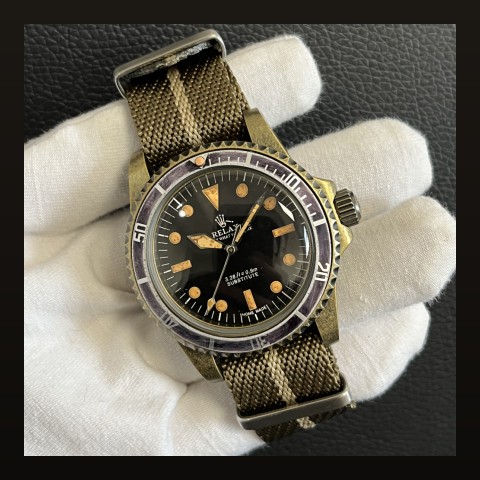
- C5: A warmer, yellowish-green emission; sometimes used for vintage-inspired dials where a "patina" glow effect is wanted
- Orange: Used by some brands for GMT hands and bezel accents; emits an orange glow that provides contrast against blue-green main lume
- Custom colors: Brands like Panerai (ECO-Strap), Luminox (T25 with tritium), and Marathon have developed proprietary lume formulations or alternative technologies
Practical Recommendations for Collectors
Choosing between BGW9 and C3 ultimately comes down to personal preference and use case:
Choose BGW9 if: You prefer the distinctive blue-green glow aesthetic, want a clean white daylight appearance on your dial, or plan to use the watch in marine environments where the aqua glow complements blue water backgrounds.
Choose C3 if: You prioritize absolute brightness in pitch-dark conditions, prefer the classic green glow associated with traditional dive watches, or want maximum compatibility with the human eye's natural low-light sensitivity.
Many modern watches now combine both compounds — using C3 for the most critical elements (hour hand, pip at 12 o'clock) and BGW9 for secondary markers — to capture the benefits of both. The Delma Oceanmaster Lume, IWC Ceralume, and Doxa SUB 250T GMT are excellent examples of this dual-compound approach in practice.
FAQ
Does lume degrade over time?
Super-LumiNova does not degrade significantly over the lifetime of a watch. Unlike tritium-based lume (which has a half-life of 12.3 years), Super-LumiNova's strontium aluminate compound retains its luminescent properties indefinitely under normal conditions. However, the luminous layer can be physically damaged by moisture ingress or improper servicing.
Can you re-lume a watch?
Yes, experienced watchmakers can re-apply Super-LumiNova to hands, dials, and markers. The process involves carefully removing old lume compound and applying new material using fine brushes or specialized applicators. Re-luming is common for vintage watches where the original lume has darkened or fallen out.
Why does my watch's lume seem weaker than it used to be?
If lume performance has noticeably declined, the cause is usually physical damage to the luminous layer (scratching, moisture exposure) rather than chemical degradation of the Super-LumiNova compound itself. In rare cases, UV exposure over decades can cause slight yellowing of the compound, which may reduce perceived brightness.
Related Reading
Sources: aBlogtoWatch (January 10, 2026, April 29, 2026), Monochrome Watches (April 15, 2026, December 15, 2025), RC Tritec technical documentation. Images sourced from original publications.