TAG Heuer Carbon Composite Hairspring Patent: A New Era in Watch Technology
TAG Heuer's Revolutionary Carbon Composite Hairspring
In the world of horological innovation, few patents have generated as much intrigue as TAG Heuer's carbon composite hairspring technology. Developed by the LVMH Group's advanced R&D division under the leadership of physicist Guy Semon, this patented innovation represents a radical departure from both traditional metal alloys and silicon-based solutions — introducing an entirely new material class to mechanical watchmaking.

How Carbon Composite Differs From Silicon
While silicon hairsprings have dominated the innovation conversation since the early 2000s, TAG Heuer's approach took a different path. The carbon composite hairspring is produced from a gas rather than etched from a solid wafer, resulting in a material with a nanoscopic hexagonal pattern structure. This distinction is critical — the manufacturing process and material properties create fundamentally different performance characteristics.
| Feature | Metal Alloy | Silicon | Carbon Composite |
|---|---|---|---|
| Shock Resistance | Bends under impact | Breaks under impact | Remains intact (tested to 5,000G) |
| Magnetic Resistance | Susceptible | Complete | Complete |
| Weight | Standard | Light | Ultra-light |
| Manufacturing | Strip forming | DRIE etching from wafer | Gas deposition |
| Collet Integration | Separate assembly | Separate assembly | Integrated during production |
The Science Behind the Patent
The development team at TAG Heuer's La Chaux-de-Fonds laboratory comprised primarily mathematicians, physicists, and chemists rather than traditional watchmakers. This cross-disciplinary approach yielded several key innovations:
Nanostructured Carbon: The hairspring material features a hexagonal pattern at the nanoscopic level (one million times smaller than a millimetre), giving it unique mechanical properties that combine flexibility with exceptional strength.
Integrated Collet: Unlike conventional hairsprings where the collet — the small component attaching the hairspring to the balance wheel axis — requires separate assembly, the carbon composite hairspring is produced with the collet already included. This eliminates a complex assembly step that traditionally introduces inaccuracy.
Aeroelasticity: When paired with a tailor-made balance wheel, the carbon hairspring achieves optimal thermal behavior and aeroelasticity — the ability to maintain consistent performance under varying air pressure and temperature conditions.
Real-World Testing Results
TAG Heuer subjected the carbon composite hairspring to rigorous testing that demonstrated clear advantages over competing materials:
- 5,000G impact test: Metal hairsprings bent permanently, silicon hairsprings fractured, while the carbon composite remained completely intact.
- Drop test from 1 metre onto hard surface: The carbon hairspring showed no deformation or damage.
- Antimagnetic testing: Complete immunity to magnetic fields, matching silicon's performance.
The Carrera Tourbillon Nanograph: Commercial Implementation
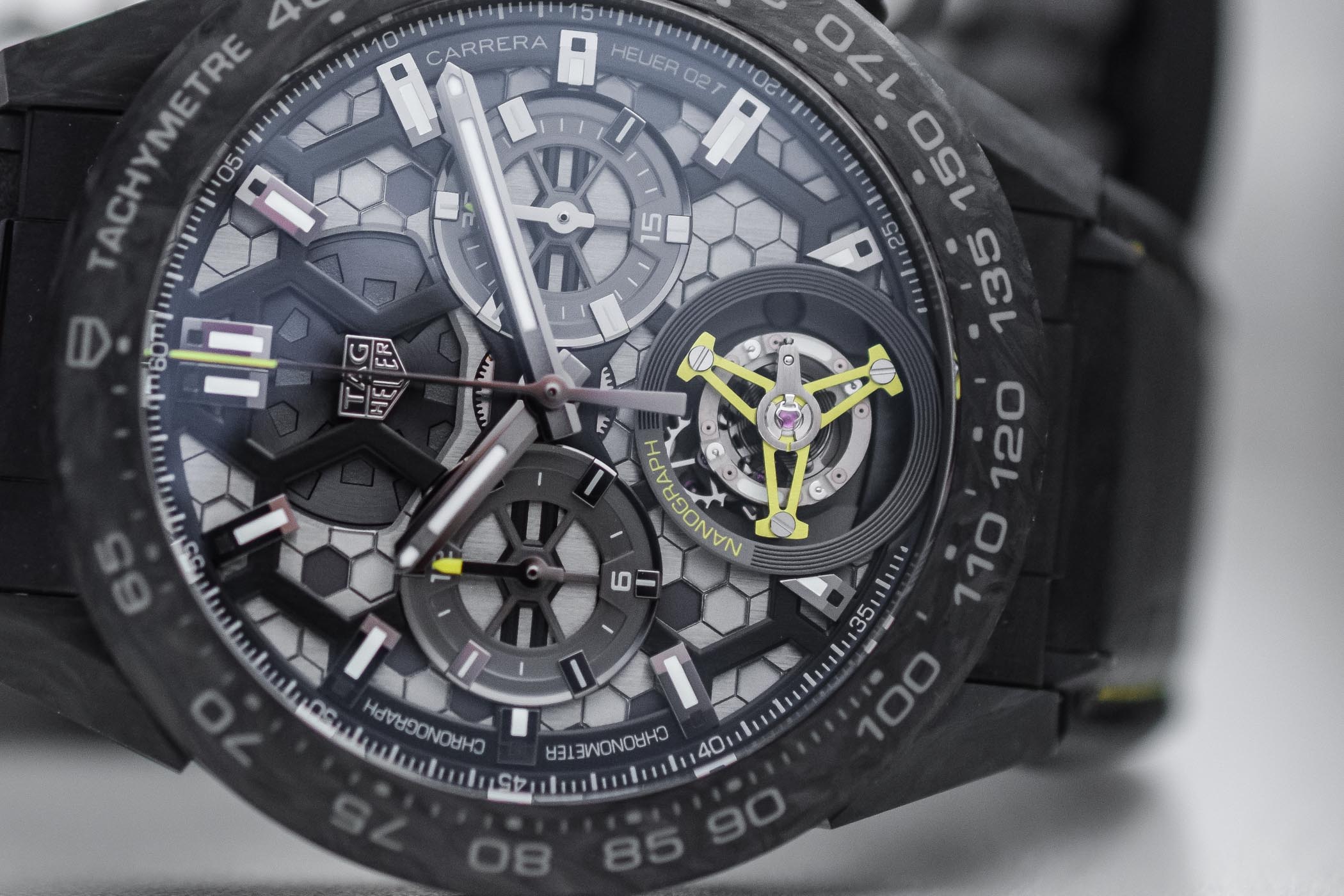
The first commercial application of this patented technology appeared in the TAG Heuer Carrera Calibre Heuer 02T Tourbillon Nanograph, priced at CHF 24,900 — a remarkably accessible price point for such advanced technology. The watch features a 45mm black PVD titanium case with carbon bezel, and the movement's hexagon-patterned dial and movement bridges visually echo the carbon hairspring's microscopic structure.
The in-house Heuer 02T calibre — the most affordable Swiss-made tourbillon chronograph — operates at 4Hz with a 65-hour power reserve. The addition of the carbon composite hairspring enhanced its chronometric performance without significantly increasing the price compared to the standard Heuer 02T models.
Broader Implications for LVMH
This patent represents more than a single watch innovation — it positions the LVMH Group as a pioneer in alternative hairspring materials. While the Swatch Group and Rolex focused on silicon, and traditional manufacturers relied on Nivarox-type alloys, LVMH carved out a third path. Guy Semon, who also developed Zenith's revolutionary Defy Lab oscillator, has demonstrated that the group's R&D capabilities extend well beyond incremental improvements.
The exclusivity of this carbon composite technology gives TAG Heuer and other LVMH brands a significant competitive advantage, as the manufacturing process and material composition remain proprietary. Unlike silicon, where the basic technology is now open following the CSEM patent expiration, carbon composite hairsprings represent a distinct and defensible intellectual property position.
FAQ
Why hasn't carbon composite become more widespread?
The manufacturing process requires specialized gas deposition equipment and expertise that goes beyond standard hairspring production. Additionally, the technology remains exclusively within the LVMH Group, limiting its adoption to TAG Heuer, Zenith, and other brands within the conglomerate.
Is carbon composite better than silicon?
Each material has distinct advantages. Carbon composite excels in shock resistance and integrates the collet directly, while silicon offers greater design flexibility through DRIE etching. The choice often depends on the specific application and brand philosophy.
Will other brands develop similar carbon-based hairsprings?
While the core material science may eventually be replicated, TAG Heuer's specific manufacturing process and composition are protected by patents. Other groups would need to develop alternative approaches to achieve similar results.
Source: Monochrome Watches — "TAG Heuer Carrera Calibre Heuer 02T Tourbillon Nanograph (with Patented Hairspring in Carbon Composite)" by Brice Goulard (January 14, 2019)
Discover More Watch Innovations | TAG Heuer Heritage Collection